
Author: Site Editor Publish Time: 2026-09-20 Origin: Site

A sudden downpour should never send your guests scrambling indoors. As a structural engineer specializing in outdoor living spaces, I have seen too many high-end patios completely ruined by a single overlooked detail: the louver joint seals. Unsealed or poorly sealed gaps allow rainwater to pour right through the metal blades, threatening expensive furniture and instantly shattering the ambiance of a meticulously planned dinner party.
While adjustable louvers offer incredible on-demand control over sunlight and natural airflow, their moving parts create inherent vulnerabilities. In this comprehensive technical guide, you will learn exactly which sealing materials work best to combat moisture ingress. We will explore how these elastomers integrate into modern architectural designs and highlight the critical engineering details you must verify before making a high-ticket investment.
EPDM Rubber is the Industry Standard: High-density EPDM rubber seals are the most effective material for completely blocking water leakage between moving louvers due to their superior compression recovery.
Integrated Drainage is Non-Negotiable: Premium seals only work when paired with an internal gutter system, forming a synergistic waterproofing barrier that channels water away from the living space.
Material Longevity Dictates ROI: Prioritize UV-resistant and temperature-stable compounds like architectural silicone or co-extruded EPDM to prevent cracking, shrinking, and premature mechanical failure.
Dynamic vs. Static Sealing Requirements: Louvered structures rely on flexible dynamic blade seals to handle daily friction, whereas fully enclosed sunrooms depend on fixed structural glazing tapes for permanent moisture control.
The outdoor construction industry is currently undergoing a massive material evolution. Recent architectural data indicates a sharp increase in consumer demand for climate-resilient outdoor structures. As extreme weather events become more frequent globally, structural engineers and top-tier manufacturers are rapidly abandoning basic PVC and felt weatherstripping. These outdated materials simply fail under the stress of modern climate extremes.
Instead, the market is pivoting heavily toward advanced co-extruded polymers that offer superior hydrostatic resistance and exceptional thermal stability. This trend reflects a fundamental shift in how we view outdoor living. Homeowners no longer want a simple fair-weather sunshade; they demand outdoor living spaces that perform with the exact same reliability and climate defense as their interior living rooms.
To effectively evaluate how to mitigate water ingress, one must first grasp the mechanical structure of a modern canopy. These structures are engineered to provide dynamic control over environmental elements, primarily through the motorized rotation of their roof blades. This dynamic movement inherently creates structural gaps where water can easily penetrate if not properly addressed by the engineering team.
Louvers are the horizontal rotating metal blades that form the primary roof. Depending on the specific model, these blades can pivot from a flat zero degrees fully closed position to upwards of 130 degrees to regulate ambient sunlight. The core issue with waterproofing arises precisely at the pivot points and the longitudinal edges where each blade meets its neighbor.
When the louvers rotate shut, the hard metal edges overlap. Without a pliable and compressible barrier wedged between these aluminum surfaces, microscopic voids remain open to the elements. Driven by wind pressure and gravity, rainwater aggressively exploits these gaps. A physical phenomenon known as capillary action can even cause moisture to creep upward through tight unsealed spaces between the overlapping blades. Consequently, the physical geometry of the louvers demands a specialized elastomeric material to fill these voids and establish a true hydrostatic barrier.
It is a widespread misconception that joint seals alone carry the entire burden of keeping a bioclimatic aluminum pergola completely dry. Effective waterproofing is actually a multi-layered system. The seals act as the frontline defense, strictly preventing precipitation from passing directly between the closed blades. Once the water is blocked, it must be efficiently redirected.
When fully closed, the louvers form a very slight pitch. The joint seals force the accumulating rainwater to flow laterally along the length of the blades toward the perimeter of the roof. Here, the water drops into a hidden gutter channel built directly into the horizontal frame beams. From this perimeter gutter, the water is channeled down through hollow vertical support posts—typically robust 120mm or 150mm extrusions—and safely expelled at the base. If the primary joint seals fail, water simply bypasses this network, rendering the sophisticated internal drainage system entirely useless.
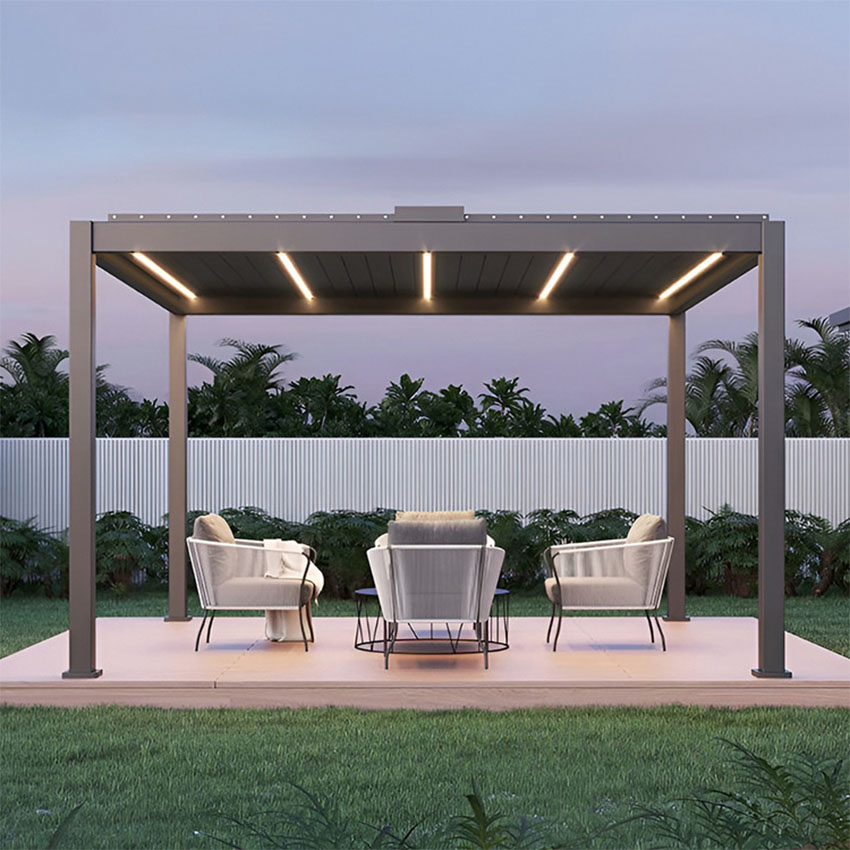
The effectiveness of a louvered roof in wet conditions relies heavily on the material science behind its weatherstripping. Manufacturers utilize various chemical compounds to bridge the gaps between blades. However, not all materials survive the brutal stress of ultraviolet radiation, drastic temperature fluctuations, and continuous mechanical friction.
Ethylene Propylene Diene Monomer, commonly known as EPDM, is universally acknowledged as the premium standard for sealing an aluminum pergola. It is a high-density synthetic rubber specifically formulated to endure extreme outdoor environments without degrading.
The primary advantage of EPDM lies in its exceptional resistance to ozone exposure and severe weather shifts. When the metal louvers rotate shut, the EPDM seal is mechanically compressed between the overlapping edges. Its incredibly high compression set resistance means it can be squeezed tightly for months during a harsh winter, yet instantly bounce back to its original plump shape when the roof is opened in the spring. Premium architectural designs utilize EPDM because it refuses to become brittle in freezing blizzards or melt into a sticky mess under the intense summer sun.
Silicone serves as another highly effective material frequently deployed in high-end outdoor architecture. Renowned for its incredible flexibility and broad temperature tolerance, architectural-grade silicone is often utilized in the complex pivot joints or along the lateral edges of the moving blades.
While EPDM typically handles the main longitudinal overlap between blades, specialized silicone gaskets excel at sealing the intricate mechanical junctions where the louvers connect to the primary frame. Silicone permanently maintains its hydrophobic water-repelling properties. This actively disrupts capillary action from pulling moisture upward through the motor mechanisms. Furthermore, it is highly resistant to chemical degradation, ensuring that environmental pollutants will not eat away at its structural integrity.
When evaluating lower-tier or budget-friendly outdoor structures, buyers frequently encounter brush seals or felt strips lining the edges of the louvers. It is absolutely critical to understand the severe limitations of these porous materials if your goal is true climate control.
Brush seals are certainly effective at dampening wind howling and blocking airborne dust. However, they are fundamentally permeable. Rather than repelling moisture, brush and felt materials actively absorb it. During a heavy rainstorm, a brush seal will quickly become fully saturated, allowing water to bleed right through the fibers and drip onto the living space below. For genuine reliable waterproofing, rigid or semi-rigid elastomeric compounds are non-negotiable.
Sealing Material | Water Resistance Level | UV & Thermal Durability | Best Architectural Application |
|---|---|---|---|
Co-extruded EPDM | Absolute Maximum Hydrostatic Barrier | Excellent 10 to 15 year lifespan | Main longitudinal blade overlaps |
Architectural Silicone | Highly Water-Repellent | Exceptional flexibility in extreme cold | Complex pivot joints and motor housings |
PVC Weatherstripping | Moderate | Poor degrades and cracks under UV | Budget structures mild climates only |
Brush/Mohair Seals | None actively absorbs water | Moderate | Dust and wind noise reduction only |
Understanding the technical specifications of polymer seals is important from an engineering standpoint. Yet, the true commercial value of these tiny components is realized in how they actively protect your financial investment and elevate your daily lifestyle. A meticulously sealed canopy shifts the function of the space from a simple fair-weather sunshade into a reliable all-weather architectural extension of your home.
Picture your carefully curated outdoor living area featuring a plush sectional sofa, delicate outdoor rugs, an integrated smart sound system, and a custom outdoor kitchen. These are significant investments that demand rigorous protection.
Without completely waterproof joint seals, homeowners are trapped in a cycle of anxiety, constantly monitoring weather apps and rushing outside to cover furniture at the first sign of a drizzle. High-quality EPDM seals eliminate this stress entirely. By forging an impenetrable shield against precipitation, these seals allow you to leave sensitive expensive items in your outdoor living area year-round. The structural integrity of the seals directly correlates to the lifespan of the furnishings housed beneath them.
A tightly sealed louvered roof transforms a fleeting seasonal patio into a versatile sanctuary. In geographic regions that suffer through heavy autumn downpours, an unsealed structure quickly becomes a dead unusable zone for several months.
By contrast, an upgraded structure equipped with factory-integrated EPDM gaskets allows you to utilize the footprint regardless of the weather. When the rain begins to fall, tapping a button to close the louvers engages the mechanical seals and instantly creates a dry cozy environment. This capability dramatically maximizes your return on investment by significantly increasing the sheer number of days the outdoor space can be comfortably inhabited.
When property owners begin researching high-end outdoor living structures, the internal debate often comes down to choosing between an adjustable louvered roof and a fully enclosed climate-controlled space. The engineering requirements for waterproofing change dramatically when comparing a kinetic moving canopy to a static aluminium sunroom.
Louvered pergolas rely entirely on dynamic seals. Because the aluminum blades rotate constantly to adjust sunlight and airflow, the EPDM rubber must withstand relentless mechanical friction, compression, and shear forces. Every single time the roof closes, the dynamic seals must actively compress against the adjacent metal to form a temporary watertight lock. This requires materials with immense rebound elasticity and tear resistance.
Conversely, a glass aluminum sunroom utilizes static seals. In these permanent structures, the heavy glass panels are permanently locked into deep aluminum extrusions. Static seals do not endure daily mechanical friction from moving parts. Instead, industrial structural silicone sealants and EPDM glazing gaskets are specifically formulated to combat thermal expansion and contraction. As the 6063-T5 aluminum frame bakes in the summer sun and rapidly cools down at night, the seals must stretch and flex slightly without ever breaking their chemical bond to the glass or metal.
Not all outdoor structures are manufactured to the same rigorous engineering standards. If you have decided that an adjustable louvered roof is the right choice for your property, ruthlessly evaluating the quality of the joint seals is paramount. Use these specific engineering criteria to assess different brands and avoid costly mistakes.
The most critical factor in louver waterproofing is exactly how the rubber seal is attached to the metal blade. Lower-tier manufacturers cut costs by using aftermarket adhesive-backed weatherstripping. Over time, relentless UV exposure causes this adhesive to melt and fail, leading to peeling strips and inevitable water leaks. If you run your finger along the seal and it feels flimsy, it is likely a cheap adhesive application.
Premium manufacturers utilize an advanced process called co-extrusion. The EPDM rubber is manufactured and bonded directly into the aluminum profile at the factory level, meaning it physically cannot peel off. Alternatively, the aluminum louver is extruded with a precise T-slot channel that the rubber seal slides tightly into. Always demand mechanically integrated seals over glued alternatives.
A high-quality rubber compound is entirely useless if the architectural design of the louvers does not apply enough mechanical pressure to it. When evaluating a pergola schematic, pay close attention to the blades in the fully closed position.
Look for a significant visible structural overlap. The edge of one louver should physically overlap the adjacent louver by at least 15 to 20 millimeters. This crucial overlap serves two engineering purposes. First, it physically crushes the EPDM rubber seal by roughly 10 to 15 percent of its volume to close any micro-gaps. Second, it breaks the upward capillary action of water. Without a tight overlap, high winds will easily push standing water uphill and right over the seal.
Even the most advanced architectural seals on the market require basic routine maintenance to function optimally. Neglecting the dynamic seals on a louvered roof will inevitably lead to water ingress regardless of the initial material quality. Implementing a simple bi-annual maintenance routine will easily extend the life of the weatherstripping.
Surprisingly, the most common cause of a leaking pergola is not a torn seal, but simple physical obstruction. Over the changing seasons, environmental debris such as pine needles, sticky pollen, and tree sap accumulate on the roof. When the louvers attempt to close, this debris gets trapped tightly between the aluminum blade and the EPDM rubber. Even a gap as small as a grain of sand can allow water to seep through during a torrential rainstorm.
Open the louvers fully to a 90-degree angle at least twice a year. Use a soft-bristled brush and a mild non-abrasive soap solution to gently wipe down the edges of the blades and the rubber seals. Avoid pointing high-pressure power washers directly at the closed louvers, as the intense concentrated water pressure can permanently dislodge the rubber from its tracks.
Rubber and silicone components are naturally susceptible to drying out and micro-cracking when exposed to wildly fluctuating temperatures over several years. To maintain the vital compression set resistance of the joint seals, they must be periodically conditioned.
Once a year, apply a high-quality 100% silicone-based lubricant spray to the EPDM seals. Spray the lubricant onto a clean microfiber cloth and gently wipe it along the entire length of the rubber. Never use petroleum-based solvents on synthetic rubber. Petroleum causes the material to swell, become sticky, and eventually disintegrate into a messy paste, which will permanently ruin the waterproofing of your canopy.
High-quality EPDM rubber effectively prevents water leakage, while architectural silicone provides excellent supplementary sealing for complex pivot joints. Purchasing a modern outdoor structure is a major financial investment, and superior sealing technology is the only true guarantee of a dry usable space. Ready to upgrade your patio with a leak-proof guarantee? Browse our collection of premium bioclimatic pergolas and sunrooms at Rodeo-Inter, or contact our engineering design specialists today to select the perfect climate-resilient structure for your home.
A premium louvered roof equipped with co-extruded EPDM seals and an integrated 120mm to 150mm internal post drainage system is engineered to handle severe downpours. High-end models can effectively manage and channel away rainfall rates exceeding 5 to 7 inches per hour without leaking onto the patio below, provided the internal gutters are kept clear of debris.
Yes, on premium architectural models, the seals are designed for serviceability. Because top-tier manufacturers use mechanical T-slot channels rather than cheap adhesives, you can simply slide the old degraded EPDM rubber strip out of the aluminum track and feed a new factory-direct replacement seal right back into place, fully restoring the roof's waterproofing capabilities.
While it is technically possible to apply aftermarket adhesive silicone weatherstripping to an older leaking pergola, it is rarely as effective as factory-integrated seals. Adding thick adhesive strips can alter the closing mechanics and strain the motor, preventing the louvers from shutting completely flush. Applying a marine-grade silicone sealant to static pivot joints may help reduce drips, but it will never perfectly replicate the watertight nature of a co-extruded EPDM system.
Under normal environmental conditions, high-density EPDM joint seals have a reliable lifespan of 10 to 15 years. This duration can fluctuate based on your geographic location. Extreme UV exposure in desert climates or heavy salt-air exposure in coastal regions may accelerate rubber wear. Reputable manufacturers specifically design their louvers so that the rubber seals can be easily replaced when they eventually degrade.
By design, a properly constructed glass sunroom is generally more watertight than a kinetic louvered pergola. Because a sunroom utilizes static seals and entirely lacks moving roof parts, there are far fewer points of potential mechanical failure. However, a premium bioclimatic pergola equipped with tightly closed overlapping EPDM-sealed louvers and an integrated internal gutter system is highly comparable, offering exceptional water resistance even during heavy rainstorms.
High-quality EPDM is specifically formulated to be anti-freeze and retains its pliable flexibility in freezing temperatures, often rated down to -40 degrees Fahrenheit. This chemical makeup prevents the rubber from becoming brittle and snapping. However, if standing water freezes solid on the roof, the resulting ice can physically bind the metal louvers together. It is always highly recommended to leave louvered roofs slightly open during heavy snowstorms to prevent ice damming and protect the motor from severe strain.


