
Author: Site Editor Publish Time: 2026-09-16 Origin: Site

Floor-to-ceiling glass doors redefine modern luxury. They create a seamless visual flow between indoor and outdoor living spaces. However, oversized architectural glass panels are incredibly heavy. Standard side hinges inevitably fail under this massive weight. This failure causes severe frame damage, structural warping, and door dragging. If you are specifying large-format glazing for a project, you must understand the exact mechanical solution. In this comprehensive guide, we explain exactly how pivot systems are engineered to support heavy glass safely and efficiently.
Vertical Load Distribution: Pivot systems transfer the immense weight of heavy architectural glass vertically into the floor. This completely bypasses the structural limitations of traditional door jambs.
Hardware is the Hero: Floor-mounted pivot boxes and specialized thrust bearings are specifically engineered to carry up to 100 percent of the active mass of the door.
Material Synergy: Premium frame materials offer the necessary strength-to-weight ratio to prevent deflection under the intense strain of double or triple-glazed units.
Design Flexibility: Advanced engineering allows for customizable opening arcs and asymmetrical weight management without compromising safety or operational smoothness.
To truly grasp how massive glass panels are supported, we must first examine the mechanical limitations of standard residential and commercial door hardware. The primary difference between a traditional entryway and a modern pivot system lies in how gravity and load distribution are managed by the surrounding architecture.
Traditional side-hinged hardware operates by exerting a horizontal pull on the frame. When heavy glass weighing between 300 and 1,000 pounds is hung in this manner, gravity relentlessly drags the unhinged side downward. This creates a severe lateral load and immense moment force or rotational stress on the top hinge and the vertical door jamb.
Over time, this continuous horizontal pulling leads to inevitable structural failures. The frame may begin to warp. The hinges can physically pull away from the wood or metal. The door itself will start to sag. More critically, the uneven stress applied to the frame can transfer directly to the rigid glass panel. This significantly increases the risk of stress cracks or hermetic seal failure in insulated glass units.
In contrast, a pivot system fundamentally changes the physical forces at play. Instead of hanging from the side of a frame, a pivot door rotates on a vertical axis created by a top pin and a bottom floor spindle.
This vertical alignment means the entire weight of the glass is driven straight down into the floor. The lateral pulling force that destroys traditional frames is completely eliminated. Consequently, the side jambs are no longer load-bearing elements. They simply serve as weather-sealing boundaries. By relying on the structural integrity of the foundation rather than the door frame, architects can safely specify expansive glass panels that would otherwise be impossible to install.
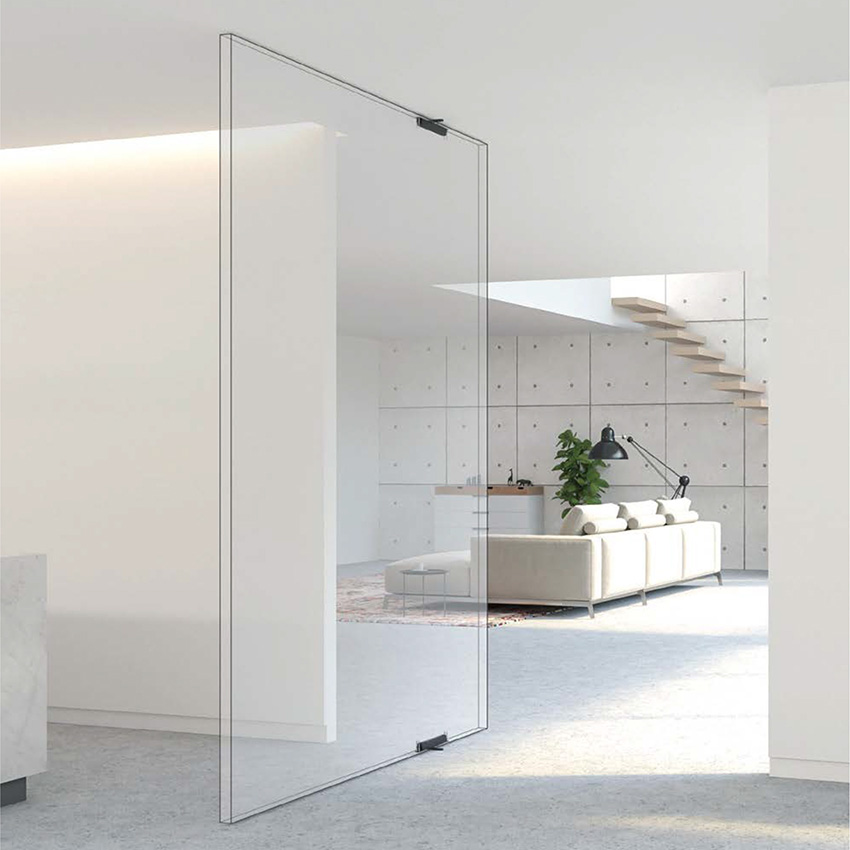
Moving beyond the basic physics, the ability to maneuver a massive glass expanse with a single finger is not magic. It is the direct result of precision-engineered hardware. The weight support system is divided into two distinct components. Each serves a highly specific structural purpose.
The bottom pivot is the absolute core of the weight-bearing system. This floor plate or spindle carries the entirety of the total mass of the door.
Hidden within the floor box, or integrated directly into the bottom rail of the door profile, is a complex assembly of heavy-duty thrust bearings. These bearings are specifically designed to support high axial loads which are forces applied parallel to the shaft. They allow the heavy glass to rotate smoothly without grinding against the baseplate. Furthermore, high-end bottom pivots often house hydraulic self-closing mechanisms and speed dampeners. These internal fluid dynamics control the swing of the massive weight. This ensures the door operates safely and predictably under all conditions.
It is a common misconception that the top pivot helps hold the door up. In reality, the top pivot carries absolutely zero weight. Its sole function is to act as a structural guide.
The top pin keeps the door perfectly upright. It dictates the axis of rotation in tandem with the bottom spindle and manages environmental stresses such as wind loads and minor building shifts. By isolating the weight-bearing function entirely to the bottom floor plate, the top header of the door frame is spared from long-term structural fatigue.
Modern architectural preferences lean heavily toward minimalism. As a result, premium pivot systems are meticulously designed to conceal these massive weight-bearing mechanics. The hydraulic boxes and thrust bearings are typically recessed entirely into the subfloor or hidden inside the bottom profile of the door frame. This concealment provides a clean and unobstructed view of the glass. It also protects the sensitive bearings from dust, moisture, and construction debris. This significantly extends the lifespan of the hardware.
Component | Primary Engineering Function | Load Bearing Capacity | Installation Location |
|---|---|---|---|
Bottom Pivot | Supports dead weight, controls swing speed, houses hydraulic dampeners | 100 percent of door mass | Subfloor or concealed in bottom door rail |
Top Pivot | Guides rotation, maintains plumb alignment, resists dynamic wind loads | Zero weight capacity | Top header or upper door rail |
Side Jambs | Houses multi-point locking systems, compresses weather seals | Zero weight capacity | Left and right frame edges |
While the floor hardware carries the vertical load, the door frame itself must hold the heavy glass rigid. If the frame flexes even slightly, the glass will crack. The choice of framing material is therefore a critical engineering decision that cannot be overlooked.
When dealing with expansive and heavy glass, adding unnecessary dead weight to the frame is a critical mistake. This is exactly why architects widely specify aluminum pivot doors for large-scale residential and commercial projects.
Extruded aluminum offers an exceptional strength-to-weight ratio. It provides the extreme structural rigidity required to hold heavy double-pane or triple-pane insulated glass units without twisting. Because aluminum itself is relatively lightweight, the pivot hardware is not overburdened by the frame. This reserves the weight capacity of the hardware primarily for the heavy glass. In addition, premium aluminum profiles feature polyamide thermal breaks. This prevents heat transfer and condensation while maintaining structural stability over decades of daily use.
For projects requiring the structural integrity of metal but the aesthetic warmth of timber, aluminum wood pivot doors provide an ideal hybrid solution. These engineered systems utilize an internal heavy-duty aluminum core to handle the weight-bearing rigidity and prevent warping. The exterior is often clad in weather-resistant aluminum. The interior features solid wood facings. This specific engineering approach ensures that the door maintains its high load capacity. Standard solid wood doors often lose these qualities when subjected to ambient moisture and seasonal temperature fluctuations.
Deflection refers to the bending or bowing of a material under load. When a heavy glass door is pushed open, the momentum creates immense stress on the frame. A strong aluminum profile prevents the frame from deflecting. Preventing this flex is vital because any bending in the frame transfers directly to the glass panel. If the frame bends, the hermetic seals of the insulated glass unit can break. This leads to condensation between the panes or the catastrophic shattering of the glass itself.
The placement of the vertical pivot axis significantly impacts how the weight of the glass is distributed and how the door behaves when in dynamic motion.
A center pivot places the axis of rotation exactly in the middle of the glass panel. However, many architectural designs require an offset placement to maximize walk-through space. In offset pivot glass doors, the pivot hardware is installed several inches or even feet away from the edge of the door rather than in the dead center.
Recent market analysis reveals a sharp rise in the specification of oversized and single-panel entry doors exceeding ten feet in height within the luxury residential sector. This architectural trend pushes manufacturers to innovate beyond standard center pivots. The industry has rapidly shifted from simple mechanical bearings to highly sophisticated fluid-dampened hardware. These modern systems are capable of managing the extreme kinetic energy of massive off-center glass spans without compromising long-term stability.
The placement of the pivot fundamentally alters the leverage and balance of the entire system. Center pivots balance the weight of the glass evenly on both sides of the spindle. This symmetrical distribution makes the door feel incredibly light to operate. The two sides counterbalance each other perfectly during the swing.
Specifically, offset pivots create a highly asymmetrical weight distribution. One side of the door is significantly heavier and wider than the other. This requires meticulously calibrated thrust bearings to manage the uneven load without tilting. The hardware must be specifically engineered to handle the increased leverage applied by the wider and heavier side of the glass panel.
When specifying large-format architectural glazing, the conversation must inevitably shift from the aesthetic appeal of the door to the structural reality of the building. Because a pivot system transfers the entirety of the vertical load directly into the floor, the integrity of the subfloor becomes the single most critical factor in the installation process.
The foundational requirements for supporting heavy glass vary significantly depending on the underlying construction materials. Failing to properly prepare the subfloor can lead to localized floor depression, hardware misalignment, and eventual glass failure.
Installing heavy glass doors on a concrete slab is generally the preferred method. However, the concrete must meet specific compressive strength requirements. For oversized glass panels weighing in excess of 800 pounds, structural engineers often recommend a minimum of 4,000 PSI at the pivot mounting location. This prevents micro-fractures over time. Furthermore, the concrete must be fully cured and perfectly level.
Wooden subfloors present a much more complex engineering challenge. Wood naturally compresses and deflects under heavy concentrated point loads. To counteract this, builders must implement severe structural blocking. This typically involves installing Laminated Veneer Lumber or custom-fabricated steel plates between the floor joists directly beneath the pivot box. This reinforcement ensures the load is distributed across multiple structural members to minimize deflection.
Because oversized glass panels are incredibly heavy and rigid, they do not offer the flexibility found in standard wooden doors. Consequently, the hardware must allow for exacting micro-adjustments post-installation. Even a millimeter of floor settling can cause a massive glass panel to drag against the threshold.
Modern high-capacity pivot hardware features multi-axis adjustment capabilities. Installers can fine-tune the lateral, depth, and vertical position of the door using internal set screws. They can do this without removing the heavy glass panel from its mounting. These precision clearances are vital for accommodating minor building settlement and thermal expansion over the years.
The physics of moving heavy glass extend far beyond static weight capacity. Once a massive glass panel is set into motion, it generates substantial kinetic energy. Managing this momentum while ensuring the system can withstand severe environmental forces dictates the long-term durability of the installation.
Momentum is the product of mass and velocity. When a homeowner pushes a 900-pound glass door, the resulting kinetic energy is immense. If this moving mass were allowed to swing freely and strike a doorjamb, the impact force would easily warp the frame or cause catastrophic glass failure.
To safely manage this momentum, premium pivot systems utilize advanced hydraulic dampening technology. These hydraulic systems force specialized fluid through precision-machined valves to create controlled resistance. Key features include a backcheck zone that activates near the end of the opening arc. This prevents the heavy door from being violently thrown open by a gust of wind. Additionally, latching speed valves ensure the heavy door gently but firmly compresses the weather seals without slamming.
Oversized glass doors are frequently installed in luxury coastal properties. Here they are subjected to extreme wind loads and driving rain. Interestingly, the very weight that makes these doors challenging to support actually becomes an asset when it comes to weather sealing.
When a massive glass panel closes, its sheer mass helps to compress heavy-duty perimeter seals far more effectively than a lightweight door could. However, this relies entirely on the rigidity of the frame and the integration of multi-point locking systems. High-quality aluminum profiles remain completely rigid even when subjected to high Design Pressure wind loads. To further enhance weather resistance, many systems employ automatic drop-down bottom seals. As the heavy door reaches the fully closed position, a mechanical trigger drops a dense neoprene seal directly against the floor threshold to block wind-driven rain and drafts.
Specifying a heavy glass pivot system requires a rigorous approach to procurement. Architects, builders, and homeowners must move beyond aesthetic considerations and verify the structural specifications of the product. Utilize this checklist during the procurement phase to mitigate structural risks.
Maximum Weight Capacity: What is the certified maximum load limit of the specific bottom pivot bearing? Ensure it exceeds the calculated weight of the glass and frame combined by at least 20 percent.
Glass Safety Standards: Is the oversized glass tempered, laminated, or both? Laminated safety glass is highly recommended for extreme sizes to prevent fallout in the event of an impact.
Thermal Performance: Are the aluminum frames thermally broken? A polyamide thermal break is absolutely necessary to prevent heat transfer and condensation in extreme climates.
Hardware Adjustability: Does the system feature three-dimensional adjustments for future maintenance without requiring the door to be uninstalled?
The successful integration of massive glass panels into a building architecture requires flawless vertical weight distribution. Pivot hardware achieves this by safely transferring heavy loads directly downward into a prepared subfloor. This completely bypasses the weak points of traditional frames. By utilizing strong extruded aluminum frames that prevent structural bending and specifying premium internal hydraulic bearings, these systems ensure effortless movement and lasting durability. When engineered correctly, even a thousand-pound glass door can be operated with absolute ease. Explore our full range of high-performance architectural solutions at Rodeo-Inter to find the perfect mechanical match for your next custom project.
High-end commercial and residential pivot hardware is engineered to support exceptionally heavy loads. Depending on the specific floor plate, the grade of the thrust bearings, and the structural integrity of the subfloor, these systems can comfortably support anywhere from 300 pounds to well over 1,100 pounds per door panel.
Yes. Because the pivot point is shifted away from the center, the weight is concentrated asymmetrically on a single offset point. This requires the subfloor to be highly structurally sound. Installations typically require a reinforced concrete slab or heavily engineered wood framing with solid steel blocking to prevent the floor from sinking over time.
Yes, provided they are engineered correctly. In premium hybrid systems, the structural core, weight-bearing rails, and exterior profiles are constructed from heavy-duty extruded aluminum. The wood serves primarily as an aesthetic interior cladding rather than a load-bearing element. This ensures the door maintains the high strength and rigidity of a pure aluminum system.
A dragging heavy glass door typically indicates one of three issues. The building subfloor has settled or shifted under the extreme weight. The bottom thrust bearing has worn out due to a lack of maintenance. Alternatively, the door simply requires a routine vertical height adjustment using the internal hardware screws to restore proper floor clearances.
No. Despite weighing hundreds or even thousands of pounds, these doors are designed for effortless operation. By utilizing precision-machined ball bearings and aligning the weight vertically along a perfectly plumb axis, friction is drastically reduced. Even a massive architectural glass door can typically be opened with a gentle push of a single finger.
Absolutely. Many high-end pivot systems can be integrated with concealed in-floor mechanical operators. These motorized systems are engineered to handle the extreme weight of the glass. They allow the door to open automatically via motion sensors, smart home systems, or biometric access controls while still maintaining their smooth hydraulic dampening.
Building settlement is a common occurrence. Premium pivot hardware is designed with this reality in mind. The concealed floor boxes and top pivots feature multi-directional adjustment screws. An installer can easily tweak the lateral alignment and vertical height of the door post-installation to compensate for minor floor shifts without needing to remove the heavy glass panel.


